How I Shipped 17,000+ Lines to a 10K-Star Open Source Project in One Week
Going from minor bug fixes to shipping full features in open source - my experience contributing to Accomplish AI during the WeMakeDevs hackathon
How I Shipped 17,000+ Lines to a 10K-Star Open Source Project in One Week
I'd contributed to open source before. Small stuff. Bug fixes under 100 lines. Nothing that made me feel like I actually understood the codebase I was touching.
The WeMakeDevs "Automate Me If You Can" hackathon changed that. The challenge was to contribute to Accomplish AI, an open source desktop AI agent with 10K+ GitHub stars. Think of it as the open source Claude Cowork, a desktop app that automates knowledge work like file management, document creation, and browser tasks. All running locally on your machine.
Two tracks: showcase an automation you built with Accomplish, or contribute to the open source codebase. I went for the open source track.
Why Accomplish
I use AI desktop tools daily. Accomplish caught my attention because it's fully open source under MIT, built on Electron with React and TypeScript, and has a real engineering team behind it. The codebase wasn't some weekend project. It had proper architecture, Jira tickets, code reviews, consolidated PRs. Real production software.
I'd never worked with Electron before. The idea of reading through someone else's production desktop app, understanding their architecture decisions, and shipping features that would actually reach users felt like the fastest way to level up.
The Contributions
I submitted 7 PRs during the hackathon week (February 16-22, 2026). Here's what I built:
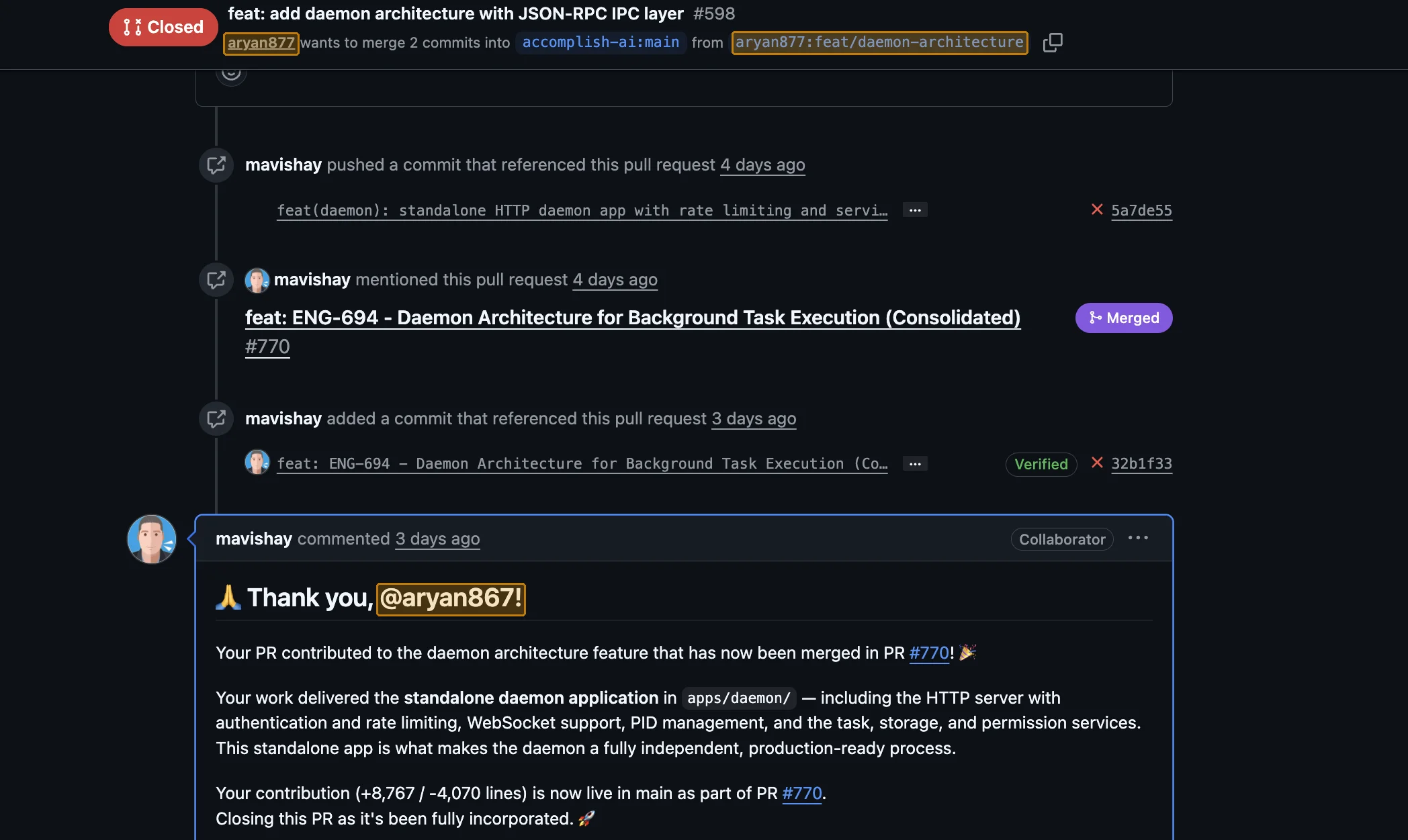
1. Daemon Architecture with JSON-RPC IPC (+8,767 / -4,070 lines)
This was the big one. PR #598.
The task was building a standalone daemon application in apps/daemon/ that could run independently. I built:
- HTTP server with authentication and rate limiting
- WebSocket support for real-time communication
- PID management for process lifecycle
- Task, storage, and permission services
- JSON-RPC IPC layer for inter-process communication
This PR got incorporated into the consolidated PR #770 - "Daemon Architecture for Background Task Execution." The maintainer's comment: "Your work delivered the standalone daemon application... This standalone app is what makes the daemon a fully independent, production-ready process."
+8,767 lines added. That single PR was bigger than most of my solo projects.
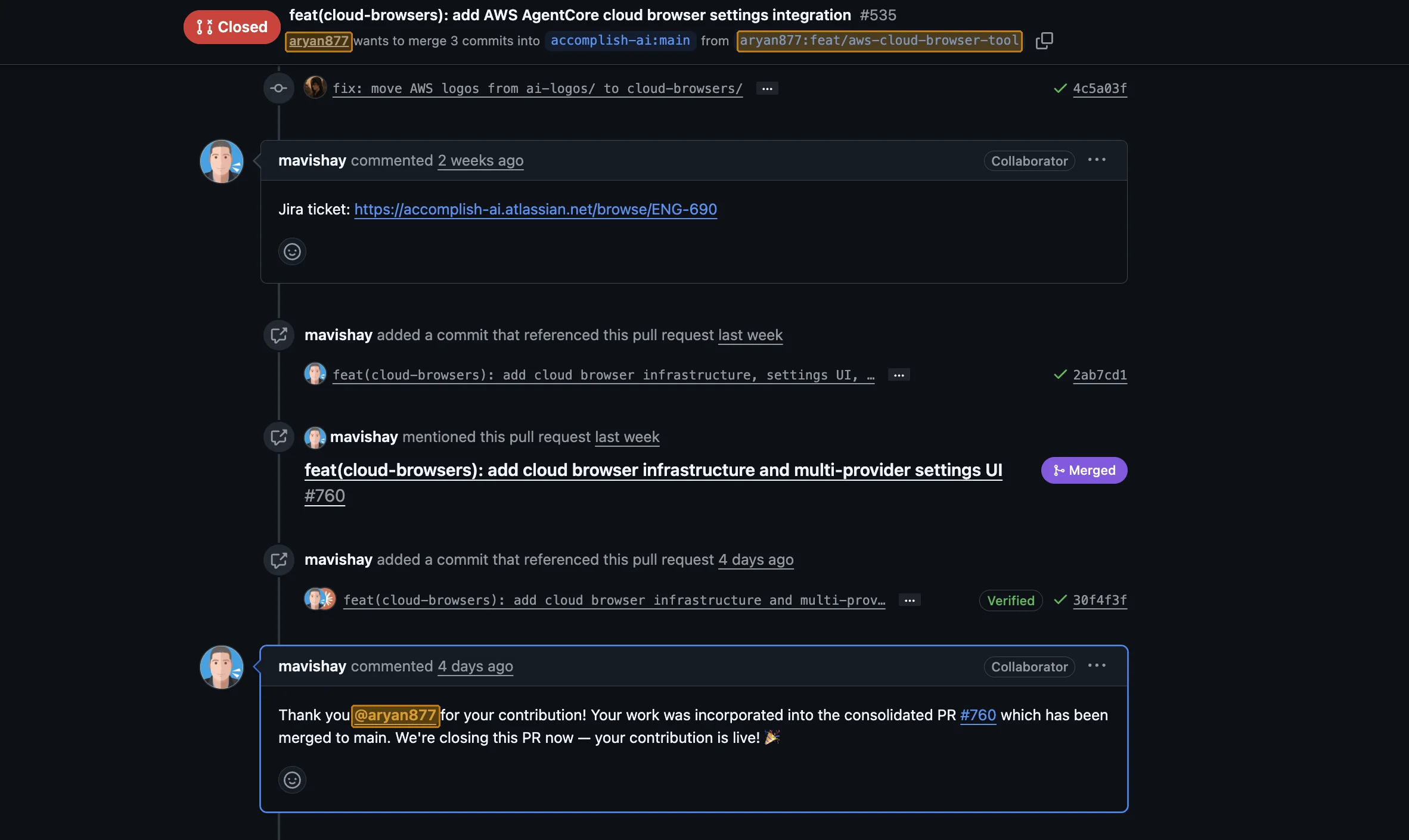
2. AWS AgentCore Cloud Browser Integration (+1,455 lines)
PR #535. Added settings UI and integration logic for AWS AgentCore's cloud browser service. This got merged into the consolidated PR #760 - "Cloud Browser Infrastructure and Multi-Provider Settings UI."
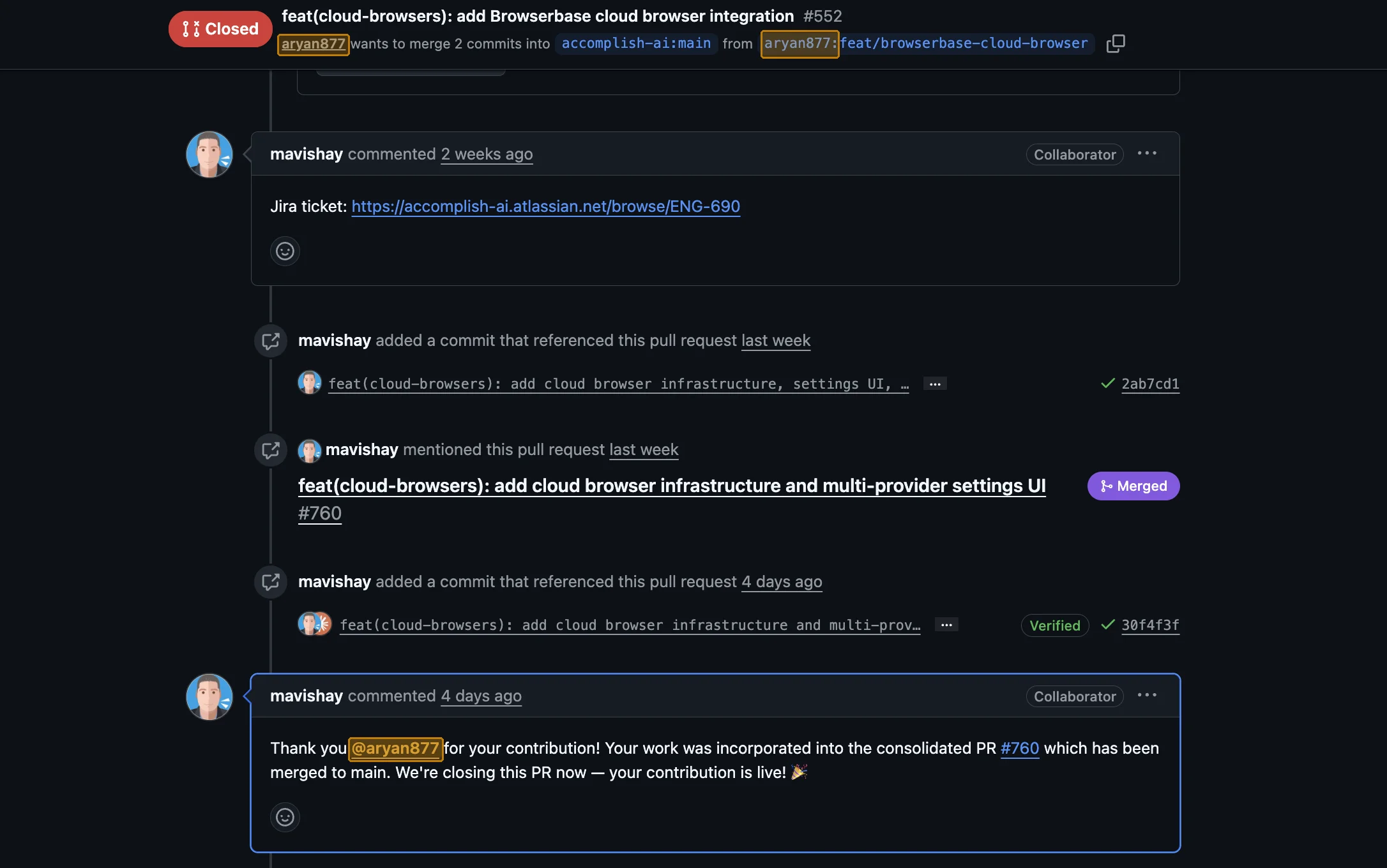
3. Browserbase Cloud Browser Integration (+1,506 lines)
PR #552. Similar to the AgentCore work but for Browserbase as a cloud browser provider. Also merged into PR #760.
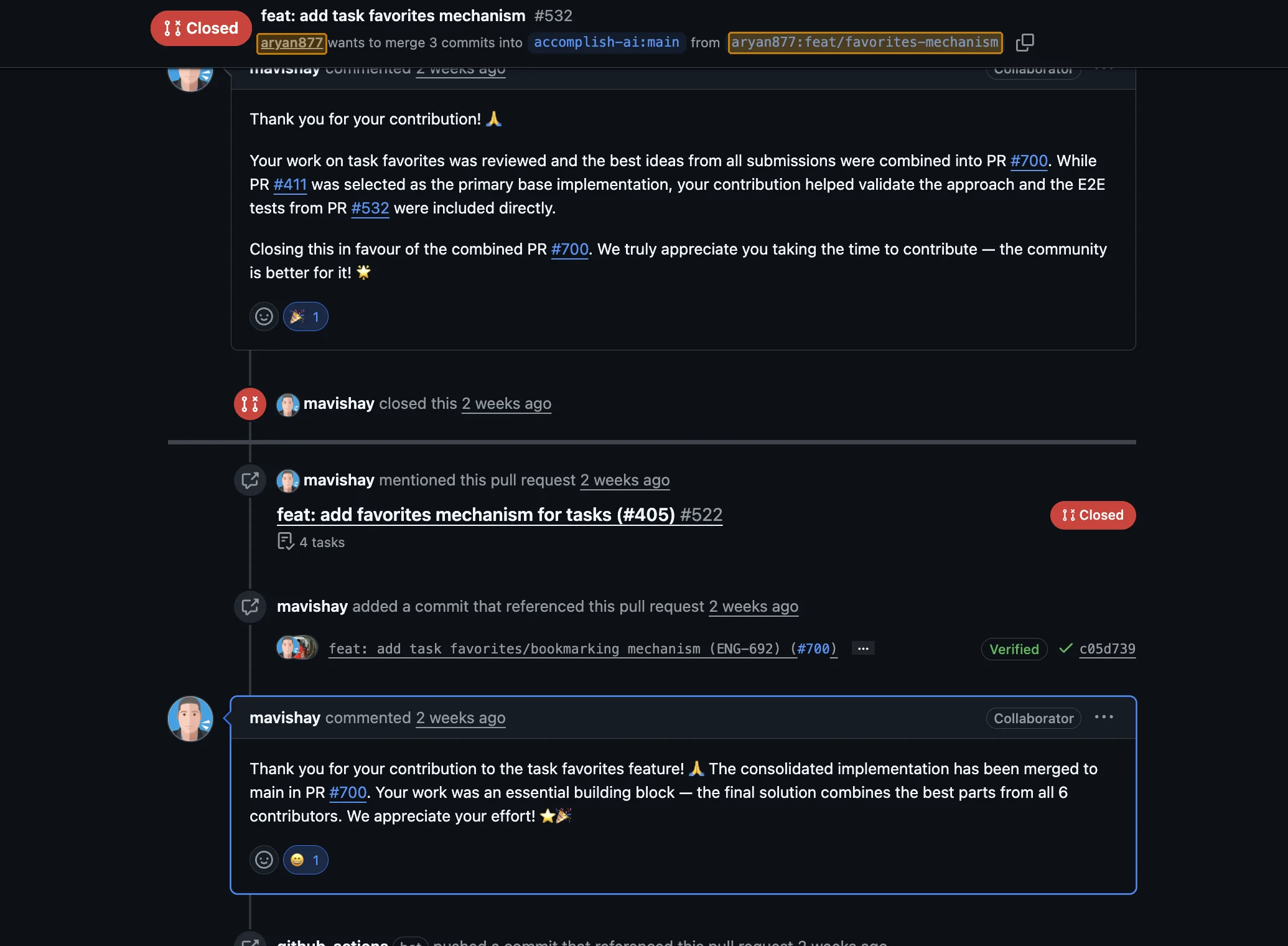
4. Task Favorites Mechanism (+517 lines)
PR #532. Built a bookmarking/favorites system for tasks. The E2E tests from this PR were included directly in the consolidated PR #700. The maintainer noted: "Your contribution helped validate the approach and the E2E tests from PR #532 were included directly."
5. WhatsApp Integration (+4,522 lines)
PR #595. Built a WhatsApp integration using a channel adapter pattern. This was a fun one because it touched a completely different part of the app, messaging and external service integration.
6. Bug Report and Repeat Task in Debug Mode (+616 lines)
PR #510. Added developer tooling: a bug report feature and the ability to repeat tasks when running in debug mode.
7. Nebius, Together AI, Fireworks, and Groq Providers (+476 lines)
PR #472. Added support for four new AI providers, expanding the model options available to users.
The Consolidated PR
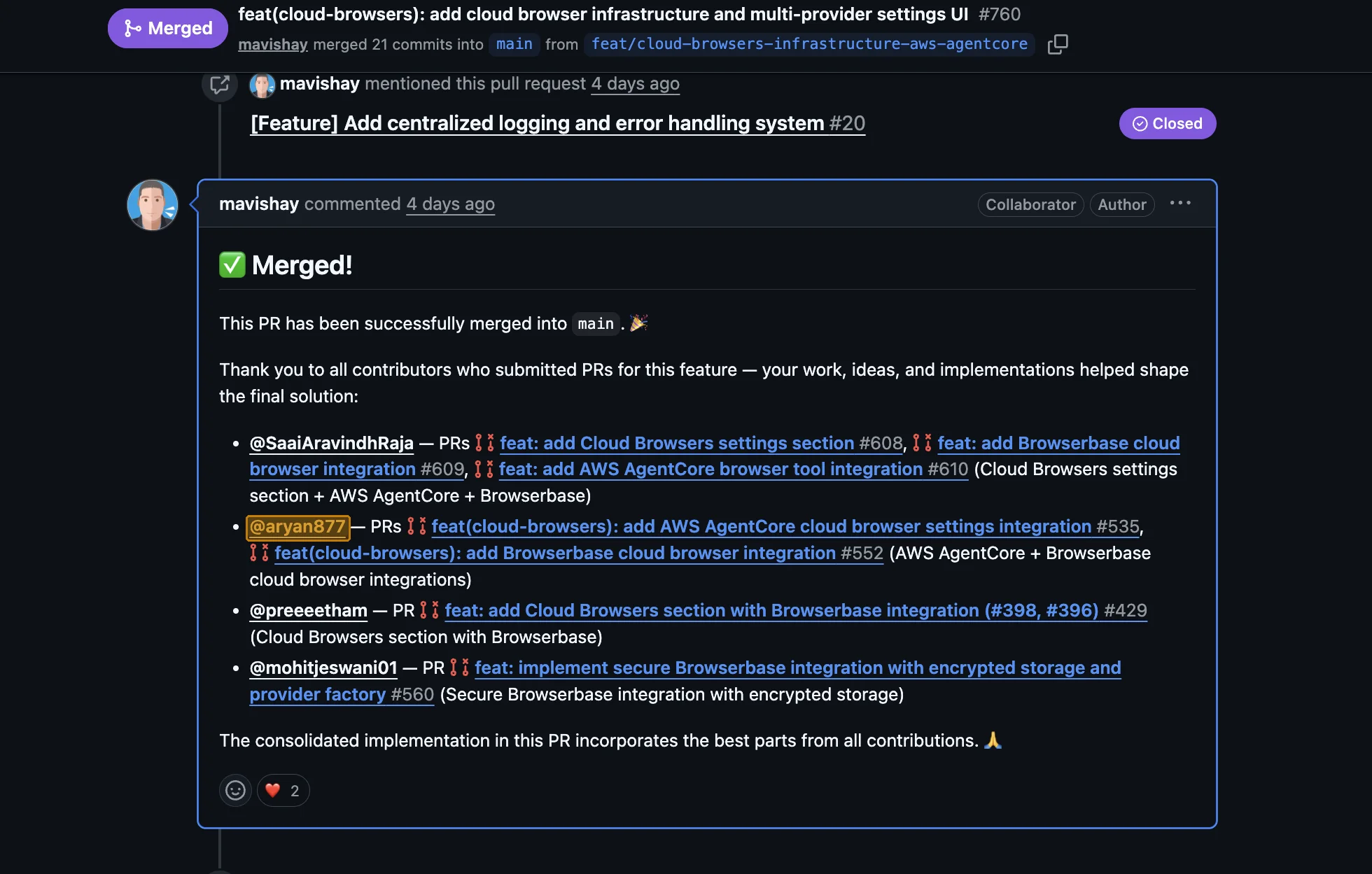
The most satisfying screenshot is this one. PR #760 - the consolidated cloud browser infrastructure PR. Merged to main, 21 commits, and my name right there in the contributor list alongside other developers.
The maintainer (Avishay Maor) took the best parts from everyone's PRs and combined them into production-ready consolidated PRs. That's how real open source works. You don't just merge raw PRs. The maintainers review, refactor, and consolidate.
What I Learned
Reading code is a skill
I spent the first day mostly reading. Understanding the project structure, how Electron's main and renderer processes communicated, how they structured their services. You can't write good code for a project you don't understand.
Electron is interesting
First time building with Electron. The mental model of having a Node.js backend (main process) and a browser frontend (renderer process) communicating via IPC was new to me. JSON-RPC over IPC for the daemon architecture made sense once I understood how Electron apps manage background processes.
Code reviews teach you things tutorials can't
The maintainers at Accomplish gave real feedback. Not rubber-stamp approvals. They pointed out architectural decisions I wouldn't have considered, patterns specific to their codebase, and production concerns around security and performance. Every review was a learning opportunity.
Open source isn't just bug fixes
Before this, my mental model of open source was: find a bug, fix it, submit a 20-line PR. This hackathon showed me that open source projects need feature work too. Entire subsystems, integrations, architectural improvements. The real contributions often come from people willing to go deep.
The Numbers
| Metric | Value |
|---|---|
| PRs submitted | 7 |
| Total lines added | 17,859 |
| Total lines removed | 4,141 |
| Largest single PR | +8,767 lines |
| PRs incorporated into main | 4+ |
| New to Electron | Yes |
| Time spent | ~1 week |
Getting Paid to Level Up
The hackathon paid $200 for my contributions. But honestly, the real value was the experience. Reading through a 10K-star production Electron app, understanding their architecture, getting real code reviews from experienced maintainers, and seeing my code ship to actual users.
If you're a developer who's only worked on solo projects, find an open source project you actually use. Look at their issues. Start with something small if you want, but don't stay small. Ship a feature. Go deep into the codebase. That's where the real learning happens.
Links
- Accomplish AI: github.com/accomplish-ai/accomplish
- PR #598 (Daemon Architecture): github.com/accomplish-ai/accomplish/pull/598
- PR #535 (AWS AgentCore): github.com/accomplish-ai/accomplish/pull/535
- PR #552 (Browserbase): github.com/accomplish-ai/accomplish/pull/552
- PR #532 (Task Favorites): github.com/accomplish-ai/accomplish/pull/532
- PR #760 (Consolidated): github.com/accomplish-ai/accomplish/pull/760
- WeMakeDevs Hackathon: wemakedevs.org
Connect
- X/Twitter: @aryankumar877
- LinkedIn: Aryan Kumar
- GitHub: aryan877
Comments (0)
Loading comments...